How to Get Recommended by ChatGPT in 2026
How small businesses get named in ChatGPT, Perplexity, and Google AI answers: what the citation studies show, what to fix on your site, and why off-site mentions win.
By Ilya Arbabi, 26 November 2026
Getting your business recommended by ChatGPT comes down to two things: making your site retrievable (indexed in Bing and Google, open to OAI-SearchBot, clear about what category you are in and what you cost) and earning third-party mentions on the exact pages AI engines already cite (YouTube videos, independent "best of" listicles, Reddit threads, and review profiles). On a fresh domain, backlinks alone barely move AI recommendations; branded web mentions and YouTube mentions correlate nearly three times more strongly with appearing in ChatGPT answers.
What the 2026 citation studies actually show
Six major citation studies covering over 680 million AI answers between late 2024 and 2026 agree on one surprise: AI answer engines do not reward the same signals that classic SEO rewarded ten years ago.
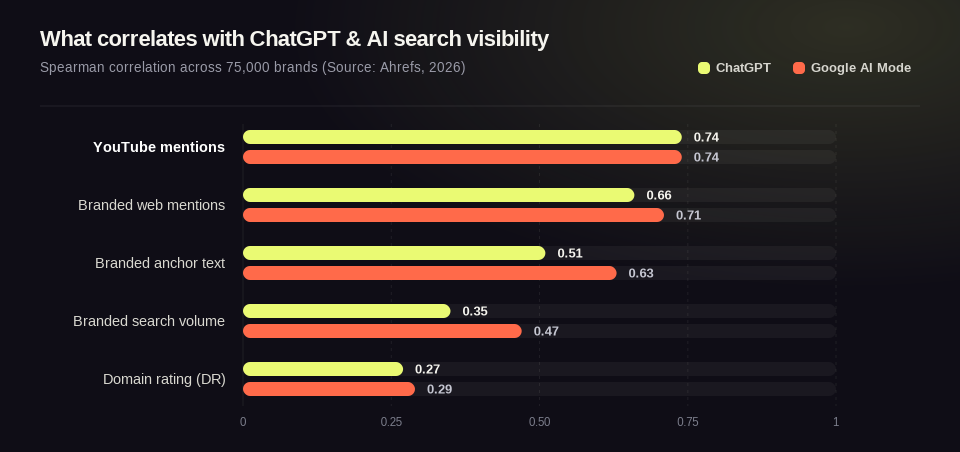
In Ahrefs' correlation study of 75,000 brands, off-site mentions dominated every technical or link-count metric across ChatGPT, Google AI Mode, and Google AI Overviews:
| Visibility factor | ChatGPT correlation | Google AI Mode | Google AI Overviews |
|---|---|---|---|
| YouTube mentions | 0.74 | 0.74 | 0.74 |
| Branded web mentions | 0.66 | 0.71 | 0.66 |
| Branded anchor text | 0.51 | 0.63 | 0.53 |
| Branded search volume | 0.35 | 0.47 | 0.39 |
| Domain rating (DR) | 0.27 | 0.29 | 0.33 |
The takeaway for a small business or new startup is encouraging: you do not need a DR 70 domain before ChatGPT can recommend you. You need your brand name mentioned beside your product category in places the retrieval layer already trusts.
Step 1: Fix retrievability in one afternoon
Before chasing mentions, make sure AI crawlers can actually read and classify your website.
- Get indexed in Bing and push via IndexNow. ChatGPT Search relies heavily on Bing's index alongside its own crawler. Verify your domain in Bing Webmaster Tools, submit your sitemap, and enable IndexNow so new pages enter Bing within hours instead of weeks.
- Check
robots.txtfor AI crawlers. OpenAI recommends allowingOAI-SearchBotif you want to appear in ChatGPT Search. Check that your CDN or firewall is not accidentally blockingOAI-SearchBot,ChatGPT-User,PerplexityBot, orClaudeBot. - Say plainly what you are in your
<title>,<h1>, and opening line. Clever taglines confuse both Google and language models. If you build an AI marketing agent or run an emergency plumbing service in Austin, put the category phrase in plain text in the title and first paragraph, along with real pricing on a dedicated/pricingpage. - Ship clean server-rendered HTML and schema. Many crawlers do not execute heavy client-side JavaScript. Serve your core words,
Organization(withsameAslinks to your official profiles),SoftwareApplicationorProduct, andFAQPageJSON-LD directly in the initial HTML response.
Step 2: Earn mentions on the pages AI already cites
When a buyer asks ChatGPT "what is the best tool for X?", the model runs a web search, reads the top listicles, review pages, YouTube transcripts, and community threads, and synthesizes an answer. If your brand is absent from those sources, your own homepage rarely rescues you.
- Find the exact listicles cited for your buyer prompts. Ask ChatGPT, Claude, Perplexity, and Google the 10 questions your buyers actually type. Export every third-party roundup URL they cite, find the author or editor, and pitch a concise, factual inclusion with your current price and one real screenshot.
- Publish focused YouTube explainers. YouTube mentions showed the highest single correlation (0.74) across all three AI answer surfaces. Short, direct videos titled around the exact buyer question, with clean transcripts and chapters, feed both Perplexity and Google AI Overviews directly.
- Answer real Reddit and Quora threads as yourself. Never fake customer accounts or buy upvotes: Reddit's July 2026 anti-spam models catch coordinated networks, and the FTC's Consumer Reviews and Testimonials Rule bans undisclosed insider endorsements. Disclose upfront that you run the company and give a genuinely helpful answer.
- Publish original numbers on your own site. Small benchmarks, teardown studies, and real pricing tables earn citations because models look for primary figures to ground their answers.
Step 3: Track citation gaps instead of guessing
Most businesses check ChatGPT once, see their competitor named, and stop. Citation sources shift fast: in late 2025, Reddit's share of ChatGPT citations swung from roughly 60% down to 10% in a single month before settling again.
A workable monthly loop is simple:
- Keep a fixed list of 10 to 20 buyer prompts (never just your own brand name).
- Check ChatGPT, Perplexity, Gemini, Claude, and Google AI Overviews on a regular schedule.
- Log which third-party URLs the engines cited whenever they left you out.
- Pitch those exact listicles, answer those exact threads, and update your own answer pages quarterly with fresh dates.
How Marsell automates this loop
Inside Marsell, our AI search visibility and GEO agent (MarCo) runs that loop every week: it checks your buyer prompts across ChatGPT, Claude, Gemini, Perplexity, and Google AI Overviews, logs every citation gap, feeds AI-cited listicles into inclusion outreach, drafts disclosed replies for fresh community threads, and writes grounded answer pages you can publish to WordPress, Webflow, Shopify, or any custom site via GitHub PR or webhook. See pricing or explore Marsell for small businesses.
FAQ
Do I need an llms.txt file to appear in ChatGPT?
No. Google has stated that llms.txt is not required for AI Overviews or AI Mode, and OpenAI has not made it a ranking requirement. It is inexpensive to publish as a clean index of your Markdown pages, so there is no harm in adding one, but real off-site mentions and crawlable HTML matter far more.
How long does it take to start showing up in ChatGPT answers?
Technical fixes (Bing indexing, OAI-SearchBot access, clearer homepage copy) can take effect within days once Bing re-crawls your pages. Earning placement on third-party listicles, YouTube, and community threads typically takes four to twelve weeks to show consistent lift across buyer prompts.
Does blocking GPTBot hide my site from ChatGPT Search?
Blocking GPTBot opts your site out of OpenAI model training, whereas OAI-SearchBot controls indexing for ChatGPT Search citations. OpenAI documents both crawlers separately so site owners can allow search citations while opting out of training if they choose.
Why does ChatGPT recommend my competitors even when my blog has more posts?
Because ChatGPT weighs third-party corroboration heavily. Fifty self-published posts on a young domain carry less citation weight than three independent roundups, two YouTube walkthroughs, and real user discussions naming a competitor.
Sources
- Ahrefs: AI Brand Visibility Correlations (75,000 Brands), accessed November 2026
- OpenAI: Overview of OpenAI Crawlers, accessed November 2026
- Google Search Central: AI Features and Your Website, accessed November 2026
- Profound: AI Platform Citation Patterns, accessed November 2026
- FTC: Final Rule Banning Fake Reviews and Testimonials, accessed November 2026